
The Wheel of the Year: Remembering How to Live in Season
Most of us live by a calendar that has very little to do with how life actually moves.
We mark time by deadlines, school terms, tax years and diary appointments. The months pass, the seasons change and often we barely notice many of the subtle transitions. We feel out of sync, tired in winter when we think we “should” be productive, restless in summer without knowing why and slightly unmoored from any real sense of natural rhythm. The Wheel of the Year offers a different way to mark time. One that is rooted in the earth, the seasons and the steady, reliable turning of nature.
It’s important to acknowledge that what we now call the Wheel of the Year is not a single, neatly preserved ancient tradition. It is a weaving together of seasonal knowledge, folklore and observances drawn from pagan European and Celtic peoples’ cultural practices. Over time, these observations about light, land, harvest, animals and weather were brought together into the eight-point framework that modern pagan, wiccan and nature-focused people recognise today. It is a modern stitching together of older ways of noticing how life moves across the year.
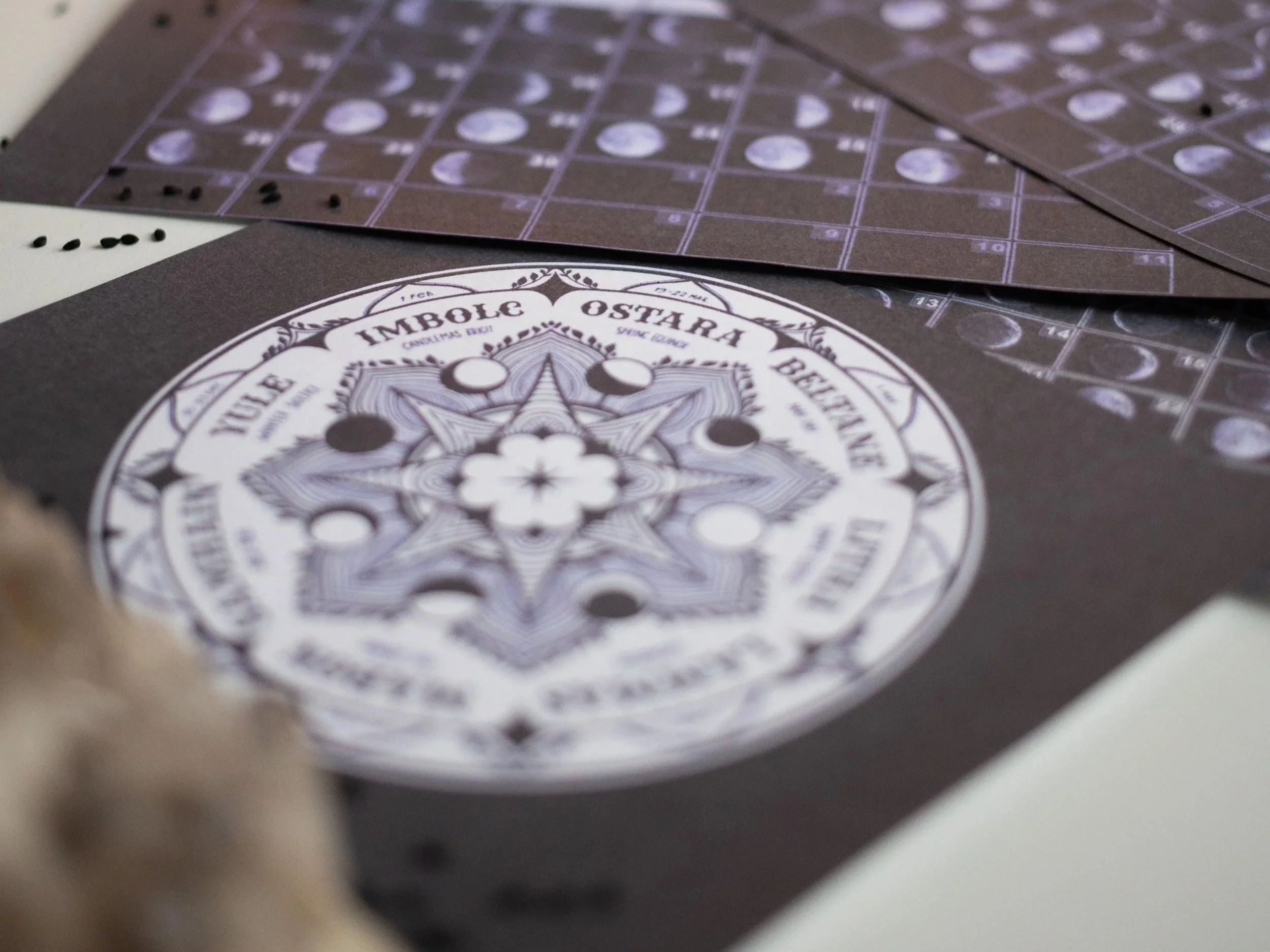
For me, this framework has become a gentle, but powerful structure for how I gather in community through This Mortal Life. Not as a religious practice, and not as something you need to believe in, but as a way of remembering how to live in season.
The Wheel marks eight turning points in the year that track the changing relationship between light and dark, growth and rest, beginning and ending. These points are observable in nature if you take the time to look. You can feel them in your body if you pay attention. The longest night of winter when the light begins to return. The subtle stirring beneath the soil in late winter. The balance of day and night in spring and autumn. The fullness of summer light. The gradual drawing inward toward the darker half of the year.
The Wheel reminds us that life is cyclical, not linear. There is a time for growth and a time for rest. A time for gathering and a time for releasing. A time for celebration and a time for reflection. Modern life rarely gives us permission for that. We live in a time where people feel increasingly disconnected from one another, from nature and from any shared sense of meaning. We are encouraged to be productive all year round, to push through winter, to keep going when our bodies and minds are asking for something different and to measure our lives by output rather than by depth.
The Wheel of the Year offers an antidote to that. It gives us permission to slow down, to notice, to come together, and to mark transitions instead of rushing past them. And perhaps most importantly, it gives us regular, reliable opportunities to gather in community with intention.
Through This Mortal Life, I use these eight turning points as anchors for gatherings across the year. Each one becomes an opportunity for people to come together and reflect on what this particular season invites us into. In winter, we light candles, share food, and honour the darkness without trying to fix it. In spring, we walk, create and talk about what is beginning to grow in our lives. In summer, we celebrate, feast and enjoy being alive together. In autumn, we reflect on what we are ready to release and what we are grateful for.
These gatherings are not performances and they are not ceremonies that require any specific belief system. They are simple, human ways of acknowledging that we are part of something bigger than our individual lives. People bring food, we walk, we sit around fires, we make small pieces of art, we talk, we listen and we remember how to be neighbours, not just individuals.
Something shifts when you mark the turning of the seasons with other people. You begin to notice the year differently. You feel less alone in your experiences. You realise that everyone is navigating their own cycles of growth, loss, rest, and renewal. You stop feeling like you are behind or failing for needing to slow down. You start to trust that there is a season for everything. In a world that often feels fragmented and isolating, simply gathering to acknowledge the passage of time together becomes a quiet but radical act of care.
The Wheel of the Year isn’t about adding more to your calendar. It’s about letting the seasons guide how you live. It’s about remembering that you are allowed to rest in winter, to begin again in spring, to feel joy in summer, and to let go in autumn. It’s about remembering that life moves in cycles, and that we move with it.
And when we do that in community, we rediscover something many of us didn’t even realise we were missing: a sense of belonging to the natural world, and to each other. If you’ve ever felt out of step with modern life, the Wheel of the Year offers a gentle invitation back into rhythm. Not through belief, but through noticing, gathering and remembering how to live in season, together.
If this way of marking time resonates with you, you’re warmly invited to join us for one of our seasonal gatherings. You can find details of upcoming gatherings on the events page. All welcome. And if you’re looking for further resources on seasonal celebrations and the Wheel of the Year, there are some great resources featured in the Resource Library. I recommend the book ‘Sacred Earth Celebrations’ by Glennie Kindred.
—-
Receive one email a month with the most recent blog posts and upcoming gatherings and events you want to know about. Sign up to the This Mortal Life mailing list and join our community to stay connected. It’s free, and it’s a lovely community to be connected to. Join us!
